
Modern Sports Coaching Tools in 2026:
A Complete Guide to Online and Offline Tools

A youth tennis coach starts her Tuesday session the way she always has cones out, resistance bands unpacked, stopwatch clipped to her waistband. Halfway through, she pulls out her phone, records a player’s serve in slow motion, and later sends the clip to the parent group with a short voice note. Nothing about this feels dramatic. It’s just how coaching happens now.
That’s the real story of sports coaching technology in 2026. Most academies aren’t choosing between “traditional” and “modern” coaching they’re doing both, often without thinking too hard about it. A coach might still run most of practice with a whistle and a clipboard, then lean on a scheduling app to sort out Thursday’s session, or a wearable to track how much load a player has taken on that week.
This guide covers the tools coaches and academies are actually using digital and physical and where each one falls short. The goal isn’t to convince you that more technology makes you a better coach. It doesn’t, automatically. The goal is to help you figure out what’s genuinely useful for your situation.
What Are Modern Sports Coaching Tools?
Broadly, these tools fall into two categories, with some overlap.
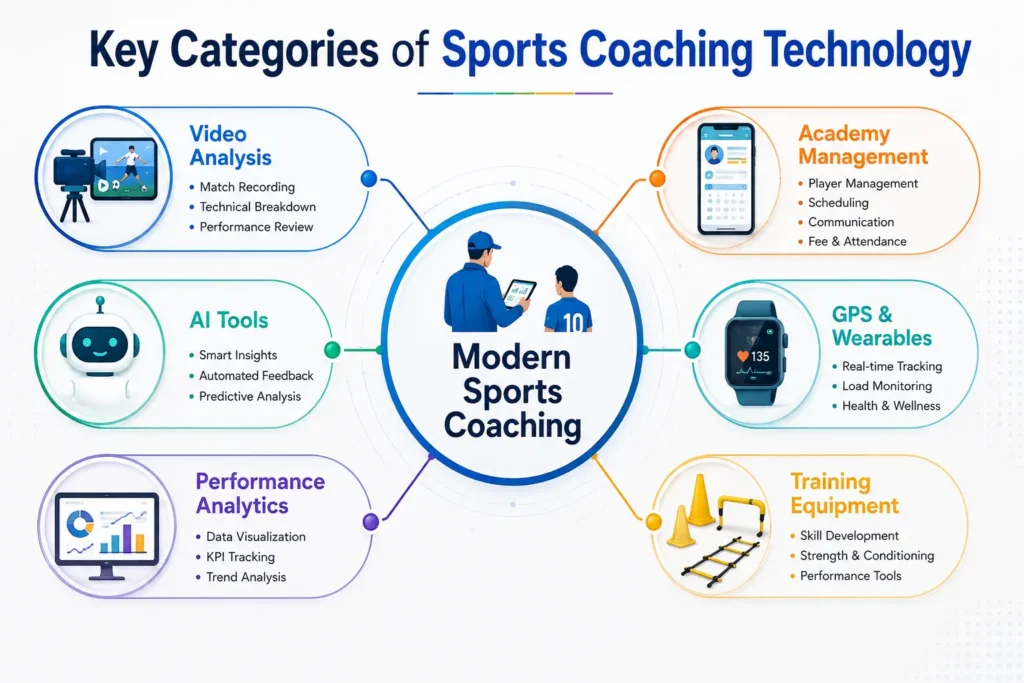
Broadly, these tools fall into two categories, with some overlap.
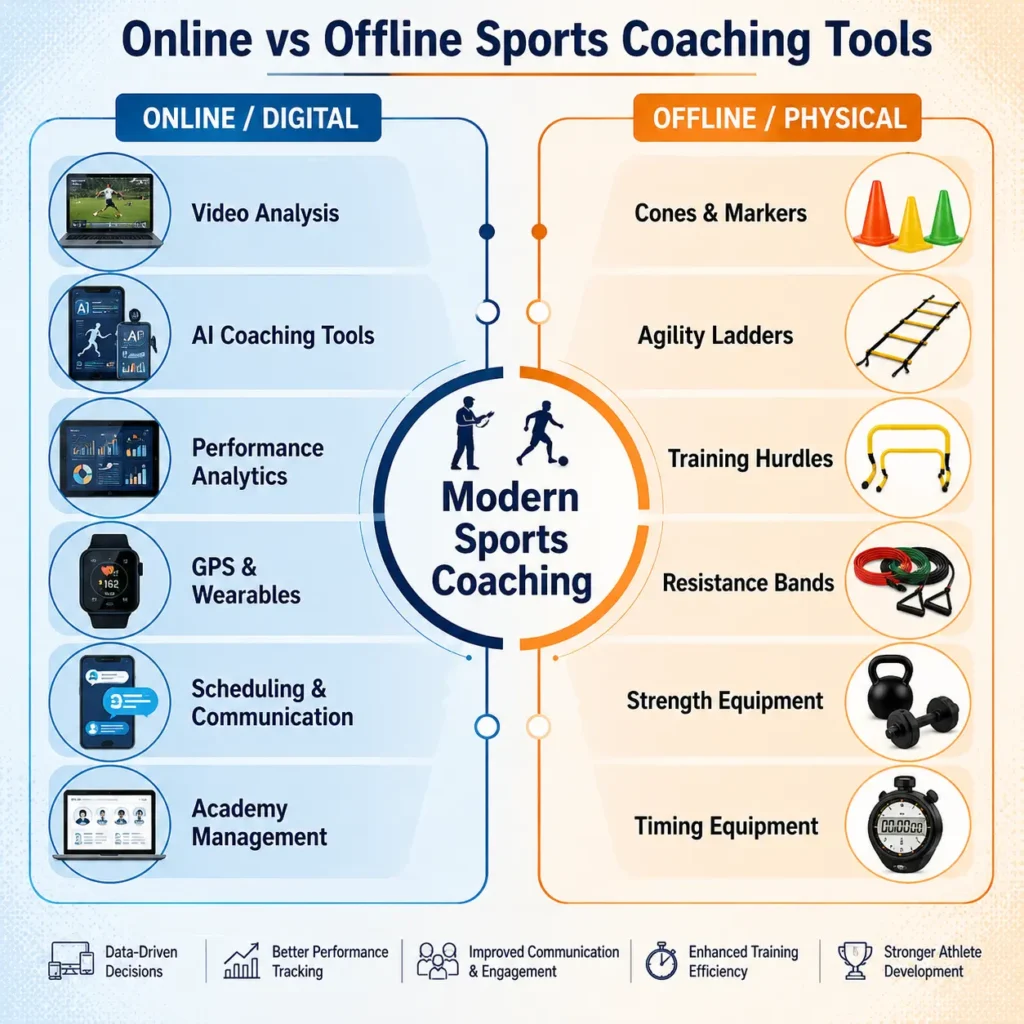
Digital or online tools include video analysis apps, AI-assisted movement tracking, performance dashboards, athlete management systems, scheduling and communication platforms, and academy management software.
Offline or physical tools are the equipment coaches have always used: cones, agility ladders, hurdles, resistance bands, timing equipment, strength gear, cameras and tripods.
A third category sits in between hybrid tools. GPS vests, heart-rate straps, and sensor-embedded equipment are physical devices, but they only become useful once their data lands in an app. A GPS vest with no platform behind it is just an expensive piece of fabric.
How Sports Coaching Technology Is Changing in 2026
The shift is practical rather than dramatic. Video feedback is faster many coaches now save short clips instantly during a session rather than reviewing an entire recording afterward. Performance tracking has become more accessible, since tools that once needed lab equipment can run reasonably well on a smartphone. Wearable monitoring has moved beyond professional sport into club and academy programs, though cost still limits how widely it’s used. Digital player records and academy management platforms have also become more common, mostly because growing academies eventually need somewhere better than a spreadsheet to keep track of who’s coming, who’s paid, and who’s progressing.
None of this means every academy needs every tool. Adoption varies by sport, size, budget, and how comfortable the coaching staff is with technology.
Online and Digital Tools for Sports Coaching
Video Analysis Tools
This is the most widely used digital tool in coaching, and the easiest to start with. Coaches record sessions or matches, then review footage in slow motion for technique, positioning, or tactics a tennis coach checking a serve’s toss height, a football coach reviewing a defensive shape from an elevated angle.
For smaller academies, a smartphone on a basic tripod is genuinely enough. Research into youth sport coaching suggests structured video review can help athletes pick up technique faster than verbal instruction alone, and helps coaches spot errors they’d otherwise miss by eye. It also seems to support athlete motivation seeing visible progress on screen tends to keep younger athletes more engaged.
AI-Powered Coaching Tools
AI in coaching largely means computer vision software that maps an athlete’s body position from ordinary video and tracks how it changes. Pose estimation tools can now track dozens of points on the body, close to real time, often on a regular smartphone. That’s genuinely useful for spotting things a coach’s eye might miss, like a knee angle that’s slightly off on landing.
The limits are around context. AI can flag a deviation from a reference model; it can’t tell you an athlete was distracted or playing through a knock. It also tends to work better for individual, repeatable movements a golf swing, a gymnastics routine than fast-moving team sports where “correct” technique depends on what’s happening around the player. AI is a useful second pair of eyes, not a substitute for a coach who knows the athlete.
Performance Analytics Platforms
Once you’re collecting data GPS numbers, heart-rate readings, test results you need somewhere to make sense of it. Analytics platforms pull that data into dashboards so coaches can track trends over weeks rather than eyeballing numbers session by session.
The honest limitation is interpretation. A dashboard full of graphs doesn’t automatically translate into good decisions. A spike in training load might signal overtraining, or it might just reflect a hard but reasonable session. Someone still needs to understand the context, or the platform becomes noise.
Online Coaching and Training Platforms
Some coaches now work with athletes in different cities. Online platforms let a coach send a plan, receive a video of the athlete performing it, and respond with feedback. This works well for structured, individual training strength programming, running plans but it can’t replace live observation. A coach watching a video afterward can’t feel how an athlete moves or adjust a drill mid-rep. It’s a useful supplement, not a replacement for in-person sessions.
Athlete Management and Player Assessment Tools
As athletes move through an academy, coaches accumulate test results, injury history, and development notes. Management tools centralize this into one profile per athlete instead of scattering it across notebooks and group chats. This matters more as an academy grows a single coach with fifteen athletes can keep it in their head; a program with several coaches and multiple age groups usually can’t, and that’s when records start getting lost.
Scheduling, Attendance and Communication Tools
Anyone running a program for more than a few months knows the specific headache of coordinating people across WhatsApp messages, paper sign-in sheets, and the occasional forgotten call about a venue change. It works until the academy grows past a certain size, and then it quietly falls apart missed sessions, parents who never got the memo, attendance nobody can verify a month later.
Scheduling software centralizes this: coaches publish a calendar, parents RSVP, reminders go out automatically. It doesn’t improve the coaching itself. It just removes friction that eats into a coach’s actual coaching time.
Sports Academy Management Software
For academies running multiple sports, age groups, or coaches, scheduling, attendance, fees, and player records often converge into one system rather than four separate tools. The appeal is practical rather than glamorous: less admin time, fewer things falling through the cracks, and records that survive a coach leaving or a season changing. Platforms like Sportstr are built around this operational side of running an academy, rather than performance analysis itself worth knowing the difference, since this kind of software won’t improve a training session, but it can free up the time a coach would otherwise spend chasing payments.
Offline and Physical Tools for Sports Coaching
None of the digital tools above replace what happens on the field. Physical equipment is still where the actual training happens.
Cones and markers are cheap, durable, and useful for boundaries, drill patterns, and visual reference points. They don’t collect data or offer feedback they’re a basic organizational tool, and that’s fine.
Agility ladders are good for footwork and coordination, and affordable enough that most academies own at least one. It’s worth being honest about their limits: ladder drills build a specific coordinated footwork pattern that doesn’t automatically transfer into better in-game agility, where movement is reactive rather than pre-set. Useful as one tool among several, not as the whole agility program.
Training hurdles support plyometric work and coordination drills. The main thing to watch is landing mechanics hurdle work done at speed with poor technique carries a real risk of ankle or knee strain, so supervision matters more than the equipment.
Resistance bands are versatile for warm-up activation, mobility, light strength work, and rehab. They’re portable and joint-friendly, but can’t replicate heavy load work, so they complement strength training rather than replace it.
Speed and reaction equipment ranges from cheap reaction balls and resistance cords to programmable light-based systems that measure response times. The pricier systems offer more precise tracking; the basic equipment still builds the same underlying skills, just without the numbers.
Strength and conditioning equipment barbells, kettlebells, medicine balls, plyometric boxes remains the backbone of physical development. This is also where supervision matters most, particularly with younger athletes still learning proper lifting mechanics.
Timing equipment ranges from a simple stopwatch to electronic timing gates and jump mats. The stopwatch is free and reliable; timing gates offer more precision for standardized testing, but cost more and need setup. For most small academies, a stopwatch and a consistent testing protocol cover most needs.
Cameras and tripods deserve their own mention because they bridge offline training and digital analysis. A basic camera on a tripod turns a physical session into footage that can be reviewed and compared over time often the most cost-effective “technology” a small academy can add.
GPS, Wearables and Athlete Monitoring
GPS and GNSS tracking measures distance covered, sprint counts, and acceleration or deceleration efforts. Coaches use it to manage training load and spot athletes doing too much, too soon. Validation studies have found that well-established GPS units can produce reliable distance measurements in team-sport conditions. The catch is cost quality units still represent a meaningful investment across a full squad, which keeps GPS tracking mostly in larger, better-funded programs.
Heart-rate monitors track internal load and are relatively affordable. Wrist-based readings are generally accurate at rest, but accuracy tends to drop during high-intensity, high-motion activity, so a sudden reading shouldn’t be treated as gospel.
Heart rate variability (HRV) is used by some coaches as a proxy for recovery. It’s a useful data point, but it’s sensitive to sleep, stress, and illness too, so it works best alongside other signals rather than on its own.
Smartwatches bundle activity, sleep, and HRV tracking into one device. Continuous wear isn’t for everyone, though some athletes find round-the-clock monitoring intrusive, and compliance tends to drop when a device feels like one more thing to manage.
IMU sensors, often built into GPS vests, measure movement patterns and joint angles in the field without a lab. They’re reasonably validated against lab-based motion capture, though sensor placement still affects accuracy.
The common thread: none of these tools tell a coach exactly what to do. They’re inputs. Interpreting them still needs someone who understands the athlete and the context a sensor can’t capture.
How Different Sports Use Modern Coaching Tools
Football coaches lean on GPS vests for workload, video for tactical review, and increasingly automated cameras that film matches without an operator. Cricket programs use slow-motion video for batting and bowling technique, alongside emerging sensor-based bats, though most coaches treat this as a starting point for discussion rather than a final verdict. Basketball coaches use video for shot mechanics and jump testing, from force plates at the elite level down to simple jump mats elsewhere. Tennis benefits from mature ball-tracking technology paired with standard video review. Swimming still depends on underwater cameras for stroke technique nothing else really substitutes alongside heart-rate tracking. Athletics coaches make regular use of timing gates and force plates for sprint and jump testing. Badminton has growing research interest in AI-based stroke recognition, though most tools remain in development rather than widely available. Multi-sport academies tend to rely most on the operational side scheduling and management software simply because coordinating several sports under one roof is a logistics challenge before it’s a performance one.
How Online and Offline Tools Work Together
This is where the real value shows up not in either category alone, but in how they connect.
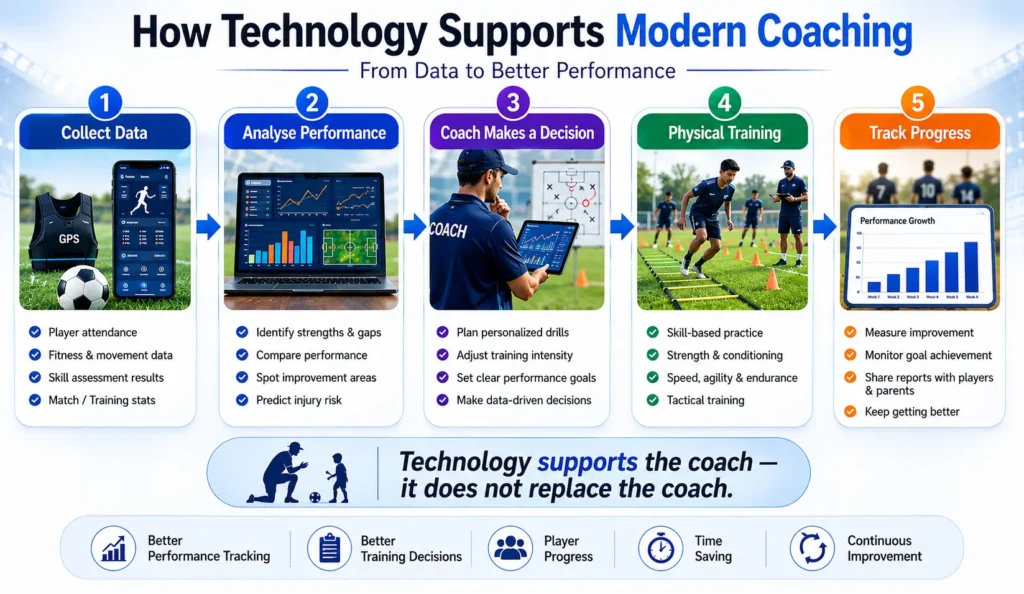
Say a coach reviews video of a player’s jump shot and spots a flaw in the follow-through. That insight came from a digital tool. Fixing it happens through repetition on the court physical drills, hands-on correction. A week later, the coach films the same shot to check whether it’s stuck. Digital tools surface the problem; offline coaching solves it; digital tools check the work.
Or take training load: a wearable reading shows a player’s workload has crept up over the week. That number alone doesn’t do anything. What matters is the coach reading it and easing off in the next physical session. The data informs the decision. The decision still happens on the field.
Choosing the Right Sports Coaching Tools for Your Academy
Before adding any tool, it’s worth asking a few questions: How many athletes and coaches will actually use it? What’s the real budget, including the time it takes to learn it? Does the sport genuinely benefit from this data? Will parents and athletes actually adopt it? And who’s responsible for interpreting what it produces?
Small academies are usually best served by a smartphone, basic camera setup, free scheduling tools, and the physical equipment every program needs anyway cones, bands, a stopwatch. Growing academies tend to benefit from academy management software for scheduling and records, better video equipment, and maybe a couple of GPS units for testing rather than kitting out the whole squad. Advanced academies with dedicated staff can make good use of comprehensive analytics and squad-wide GPS tracking but even here, the tools only pay off if someone has the expertise to use the data properly.
Expensive technology doesn’t automatically mean better coaching. It means more data and more responsibility to use it well.
Benefits of Modern Sports Coaching Tools
Used thoughtfully, these tools offer real advantages: more precise feedback than verbal description alone, smoother academy operations with less manual chasing, player records that don’t disappear when a coach moves on, time saved on admin that would otherwise eat into coaching hours, a fuller performance picture where monitoring is genuinely warranted, more centralized communication, and when interpreted properly more informed training decisions.
None of these benefits are automatic. They depend on the tool suiting the situation and someone knowing how to use what it produces.
Limitations and Risks
Cost is real a lot of advanced equipment and software genuinely isn’t accessible to smaller programs. Data quality matters too: poorly calibrated sensors produce numbers that look precise but aren’t. Privacy is a growing concern, especially with youth athletes, and academies need to think carefully about consent and data storage rather than default app settings. There’s a real risk of over-reliance, where a dashboard starts substituting for a coach’s judgment instead of supporting it. Poor interpretation is arguably the most common failure data without the expertise to understand it is close to useless. AI tools still have real limits around context. And too many metrics and dashboards can simply lead to both coaches and athletes tuning out.
Why Technology Should Support the Coach Not Replace the Coach
Sensors measure. Video shows. AI identifies patterns. Software organizes. That’s genuinely useful but none of it coaches. A sensor can’t tell an athlete it believes in them before a big match. A dashboard can’t read the room after a tough loss. AI can flag a technical flaw, but it can’t build the trust that makes an athlete willing to actually change how they move. That still comes from a person who knows the athlete and has built a relationship over time.
The coaches getting the most out of modern tools tend to treat them as an extension of judgment, not a replacement for it. The technology tells you something happened. The coach still decides what to do about it.
Where Sports Academy Management Software Fits
As academies grow, the operational side starts to demand as much attention as the coaching itself scheduling across shared facilities, tracking attendance across coaches, collecting fees without chasing people down, keeping player records organized across seasons. None of this is coaching, but all of it eats into a coach’s time without a system behind it.
Sportstr is one example of this kind of platform, built around the day-to-day running of a sports academy scheduling, attendance, fee management, player records, and academy operations rather than performance analysis itself. The value isn’t flashy; it’s mostly about reducing the number of things a coach has to remember or chase manually. For a growing academy juggling multiple coaches and age groups, that can free up meaningful time for actual coaching.
The Future of Sports Coaching Technology
A few developments seem likely to matter. Computer vision should keep getting more accessible on ordinary smartphones, giving more coaches not just well-funded programs reasonable access to movement analysis. Wearable technology should keep improving in accuracy and comfort, which may help with the compliance issues limiting continuous monitoring today. AI feedback tools are likely to get better at translating raw data into something a coach can act on. Academy management platforms will probably keep consolidating more functions into single systems. And data privacy, particularly around youth athletes, is likely to get more attention as more sensitive information moves onto digital platforms.
What’s already useful today: video review, basic performance tracking, scheduling and academy management software, and pose-estimation tools for individual sports. What’s still developing: fully autonomous AI coaching, biochemical monitoring, and reliable AI-driven tactical decision-making for team sports. Worth watching, not worth over-investing in yet.
Conclusion
The best coaching toolkit isn’t necessarily the most expensive one. A smartphone, a set of cones, some resistance bands, and a well-thought-out training plan can be genuinely effective plenty of good coaching still happens with exactly that. Larger academies with the budget and expertise to match may get real value from advanced analytics, wearables, and management platforms. Neither approach is wrong.
The right tool is simply the one that solves a real problem you actually have. Everything else is optional. Good coaching was never really about the equipment it’s about what you do with it.
FAQ
What are modern sports coaching tools?
They’re the mix of digital platforms video analysis, AI-assisted tracking, wearables, academy management software and physical training equipment like cones, resistance bands, and timing gear that coaches use to plan, deliver, and review training.
What technology do sports coaches use?
Most use some combination of smartphone video, scheduling and communication apps, and increasingly wearables like GPS vests or heart-rate monitors, depending on the sport and available resources.
Are sports coaching tools useful for small academies?
Yes, but it’s worth starting simple. A smartphone for video, free scheduling tools, and basic equipment like cones and bands cover a lot of ground before more expensive technology like GPS tracking becomes worthwhile.
How is AI used in sports coaching?
Mainly through computer vision and pose estimation, which tracks an athlete’s movement and flags technical details a coach might miss. It works best for individual, repeatable movements and alongside a coach’s judgment, not in place of it.
What is the difference between online and offline coaching tools?
Online tools are software-based video analysis, dashboards, communication apps. Offline tools are physical equipment used during training, like ladders, hurdles, and strength equipment. Most effective coaching uses both together.
How can sports academy management software help coaches?
It centralizes scheduling, attendance, fee collection, and player records into one system, reducing the administrative work that would otherwise eat into a coach’s actual coaching time.