
How Modern Sports Academies Reduce High Coach Turnover


It usually starts with a message in the parents’ WhatsApp group: “Coach Priya will no longer be taking the U-12 batch.” No real explanation, just a name and a replacement, sometimes filled in a week later.
Behind that one line is a familiar chain reaction. Players who trained under that coach for two seasons have to adjust to someone new mid-cycle. Another coach absorbs the extra sessions on top of an already full week. Parents start asking questions the front desk wasn’t prepared for. Someone has to rebuild the schedule and hope the new coach picks up where the last one left off.
Often, nobody fully does a season’s worth of notes on individual players tends to leave with the coach who kept it in their head.
This is the part that gets missed when coach turnover is treated as a staffing inconvenience. It’s an operational problem that touches almost everything an academy is trying to build: consistent coaching, athlete development, parent trust, and a reputation that outlasts any single instructor. Improving sports academy coach retention isn’t just about keeping people happy it’s about protecting the continuity that players and parents actually notice.
This article looks at what the research says about why coaches leave, separates what’s reasonably well supported from what’s assumed, and lays out what academies can realistically do about it.
Is Coach Turnover a Serious Problem for Sports Academies?
There isn’t a large body of research measuring turnover specifically inside commercial youth sports academies, so it’s worth naming that gap upfront. What does exist comes from adjacent settings youth sport more broadly, athletic clubs, collegiate and high-performance programs and the pattern across those settings points in a consistent direction.
- High Turnover in Structured Programs: A review of youth-sport coaching literature describes coach turnover as a persistent concern, particularly at the youth level, where roles are often part-time, seasonal, or volunteer-based. In organized university sport, where the data is more formal, a recent report tracking NCAA Division I women’s head-coaching positions found that 24.5% of those roles turned over across a two-year window. That isn’t academy data and shouldn’t be read as one, but it’s a useful signal: even in well-resourced, professionally structured programs, coaching turnover runs high enough to be treated as a serious metric rather than background noise.
- The Layered Nature of the Coaching Role: A coach isn’t just delivering sessions — they’re often handling attendance, fielding parent questions, coordinating transport, and doing paperwork unrelated to actual coaching. Stacked together, week after week, these responsibilities start to resemble a second job layered on top of the first.
The cost of losing a coach rarely shows up as a single line item, but it’s real: recruitment and onboarding time, disruption to a player’s development when the person tracking their progress changes mid-season, extra load on remaining staff, and the slow erosion of institutional memory that makes an academy feel like more than a rotating cast of instructors.
Why Sports Academy Coaches Leave
There’s rarely one reason. Coaches typically leave because several pressures build up at once, and coaching research inside and outside commercial academies points to a fairly consistent set of factors:

- Compensation and Job Security: Coaches in a South African study reported dissatisfaction not just with pay, but with administrative workload, community support, and job security together, suggesting compensation problems rarely exist in isolation. Separate research on high-performance coaching notes that short-term contracts and unstable employment are common features of the profession. For academies, this points to something beyond the headline salary number: predictability matters. Coaches want to know when they’ll be paid, whether their contract will be renewed, and what happens in the off-season.
- Excessive or Unmanaged Workload: This is one of the better-supported findings in the research. A 2019 study of 464 Australian sport coaches found that workload manageability and control over one’s schedule were both positively associated with coach wellbeing, and the effect wasn’t small a one-unit increase in workload manageability was linked to roughly a 2.8-unit increase in wellbeing scores, with work-life control showing an even larger association. A separate 2024 study of 207 competitive coaches in China found a moderate positive correlation between job pressure and occupational burnout ($r = 0.436$), and a negative correlation between organizational support and burnout ($r = -0.349$). These are single-sample findings rather than universal laws, but the direction is consistent: lower control over workload and scheduling may be associated with poorer wellbeing and greater burnout risk.
- Administrative Burden: For many coaches, the strain isn’t limited to coaching itself. Research on soccer-academy coaches found that administrative tasks paperwork, transport coordination, fee follow-ups were frequently described as excessive and disconnected from the actual work of developing players.
- Burnout and Work-Life Conflict: A scoping review of coach burnout research found that all three recognized dimensions of burnout emotional exhaustion, depersonalization, and reduced sense of accomplishment were strong predictors of coaches’ intention to leave. The evidence supports a link between burnout and wanting to quit, not proof that burnout directly causes every departure, but when a coach starts dreading a role they used to enjoy, it’s rarely a good sign for how long they’ll stay.
- Poor Management and Communication: Coaching-stressor research repeatedly surfaces vague expectations, weak organizational support, and poor communication from leadership as recurring sources of frustration. Coaches who don’t know where they stand tend to disengage well before they formally resign.
- Limited Career Progression: Coaches don’t always leave for more money. Sometimes it’s a better title, a more established program, or simply the sense that there’s somewhere to go. Research on coach retention notes that coaches often move toward opportunities to work with higher-level athletes or more established organizations which says as much about the absence of a path at their current academy as it does about the pull elsewhere.
- Parent and Athlete-Management Pressure: This shows up especially strongly in youth-sport research. Studies on volunteer and community coaching identify insufficient support from parents, along with the emotional labor of managing family relationships, as a recurring source of stress.
- Lack of Autonomy: Tied closely to workload, the Australian coach wellbeing study found that greater perceived control over coaching tasks was associated with better wellbeing outcomes. Coaches given no input into decisions affecting their own working conditions are more likely to feel like they’re clocking in than building something.
How Modern Sports Academies Can Improve Coach Retention
None of the factors above have a single fix, but together they point toward a few concrete shifts academies can make:
- Make Compensation Predictable, Not Just Competitive: Publish pay rates and payment dates. Pay for planning time and travel where possible, not just contact hours. A coach who knows exactly when and how much they’ll be paid tends to trust the organization more than one chasing down a payment every month, even at a similar salary.
- Build a Visible Coaching Career Path: This doesn’t need to be elaborate assistant coach, lead coach, senior coach, and a technical or development-lead role, each with clear requirements, gives coaches a reason to think in years rather than seasons. Dedicated coach management tools can help keep certifications, roles, and progression documented in one place instead of scattered across spreadsheets and memory.
- Support Real Professional Development: The research here is more nuanced than it might seem one study on sport providers found that training frequency alone didn’t significantly predict lower stress or higher job satisfaction. Training tends to help only when it’s relevant, paid for, scheduled during working hours, and tied to an actual next step, not handed out as an optional add-on nobody has time to use.
- Recognize Contribution, Not Just Wins: Coach job-satisfaction research identifies recognition as a meaningful factor in how coaches feel about their role. That doesn’t have to mean formal awards; consistent, specific acknowledgment of things like athlete development or a difficult parent situation handled well tends to matter more than a generic “great season” message.
- Give Coaches a Voice in Decisions: Scheduling, team assignments, session length coaches who have input into these decisions report better wellbeing than those who simply receive a finalized calendar. This doesn’t mean every decision becomes a committee vote; it means asking before assuming.
- Improve Scheduling and Workload Planning: Given how strongly workload manageability and control are tied to wellbeing in the research, this is one of the most practical areas academies can act on directly. Collecting coach availability before building the timetable, avoiding unnecessary split shifts, and building in recovery time after tournaments are practical, low-cost changes and a core part of good coach workload management. Purpose-built sports academy scheduling tools can give coaches visibility into their own week instead of discovering changes after the fact.
- Set Clearer Communication Standards: Weekly updates, defined escalation paths for problems, and advance notice of policy changes all address the “poor management” factor that shows up repeatedly in the research. Most of this costs nothing but consistency.
- Strengthen Manager Support: Organizational support was one of the stronger protective factors against burnout in the research cited above. In practice, this looks like regular check-ins where a manager actually listens, rather than a once-a-year performance review that covers everything except how the coach is actually doing.
Reduce Administrative Work Without Removing Coaches From the Process
It’s worth being precise about what “administrative burden” actually means, because the solution isn’t to strip coaches out of every process involving data or communication. It’s to stop routing repetitive, low-value work through them by default.
Coaching work is session design, athlete observation, and the kind of individualized attention that actually develops players. Administrative work is attendance logging, fee follow-ups, repeated scheduling messages, and answering the same parent question for the fifth time that week.
Rule of Thumb: If a task requires coaching judgment, it should sit with the coach; if it doesn’t, it probably shouldn’t.
- Fee Collection: Chasing overdue payments pulls a coach’s attention away from athletes and into a financial conversation they didn’t sign up for. Centralizing that through an admin workflow or automated fee management tools removes a category of friction without removing the coach from anything that actually benefits from their expertise.
- Attendance Tracking: A coach still needs to know who showed up; they don’t need to be the one reconciling a paper register at the end of the month. Using digital attendance management tools lets coaches record roll calls in seconds on the field without getting buried in paperwork.
How Technology Can Support Coach Retention
There isn’t independent research proving that any specific piece of sports academy software reduces coach turnover. What the broader research does support is more modest but still meaningful: workload manageability and administrative burden are linked to coach wellbeing, and tools that genuinely remove repetitive work have a plausible path to reducing that burden.

A tool that just moves the same manual work into a new interface doesn’t help; one that actually removes it can.
In practice, this tends to show up in a few areas:
- Scheduling and Batch Management: Coaches avoid manually reconciling conflicting timetables across venues and age groups.
- Attendance Tracking: Paper registers are replaced with sideline check-ins completed in seconds.
- Player Records: Kept in one central system instead of split across notebooks and memory. Dedicated performance tracking tools give coaches a continuous record rather than starting from scratch each season.
- Parent Communication: Centralized communication channels cut down on the repeated direct messages that eat into a coach’s personal evenings.
Academies still running on spreadsheets and messaging groups often don’t realize how much coordination time that setup quietly demands until they see it consolidated. That’s the practical argument for a platform like SportStr’s sports academy management software not that it will prevent burnout or guarantee retention, but that it removes friction that otherwise lands on coaches by default. Whether that translates into someone staying an extra season still depends on far more than software: pay, management, career path, and culture all matter more.
Coach Retention Challenges Across Different Academy Environments
Retention pressure doesn’t look identical everywhere. A youth academy, a community club, and an elite performance program deal with different versions of the same underlying problem:
- Youth Academies: Lean heavily on parent management, evening and weekend scheduling, and maintaining player safety alongside long-term athlete retention.
- Community Clubs: Especially volunteer-run programs, these struggle more with fundraising demands and thin administrative support.
- Elite / High-Performance Programs: Face intense performance pressure, heavy travel, and less job security than the results-driven environment might suggest.
- Multi-Location Academies: Introduce compounding travel time and scheduling complexity across different facilities.
- School-Linked Programs: Built around academic calendars and often staffed by part-time coaches juggling this alongside other work.
Academies that recognize which pressures are most acute in their own environment design more targeted responses than those applying one generic policy across every program.
How to Measure Coach Retention
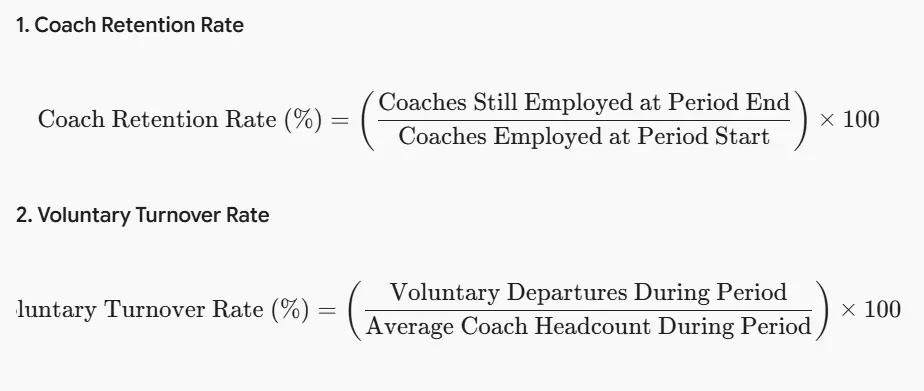
Most academies can describe turnover anecdotally “we’ve had a lot of coaches leave lately” long before they can quantify it. Clear metrics help verify whether retention efforts are working:
Supporting Diagnostic Metrics
- Six-month retention for new hires: Highlights early onboarding and role alignment.
- Administrative hours logged per coach: Tracks non-coaching clerical volume.
- Documented exit reasons: Captures honest feedback through consistent exit interviews to locate operational weak points.
A Practical 90-Day Coach Retention Plan
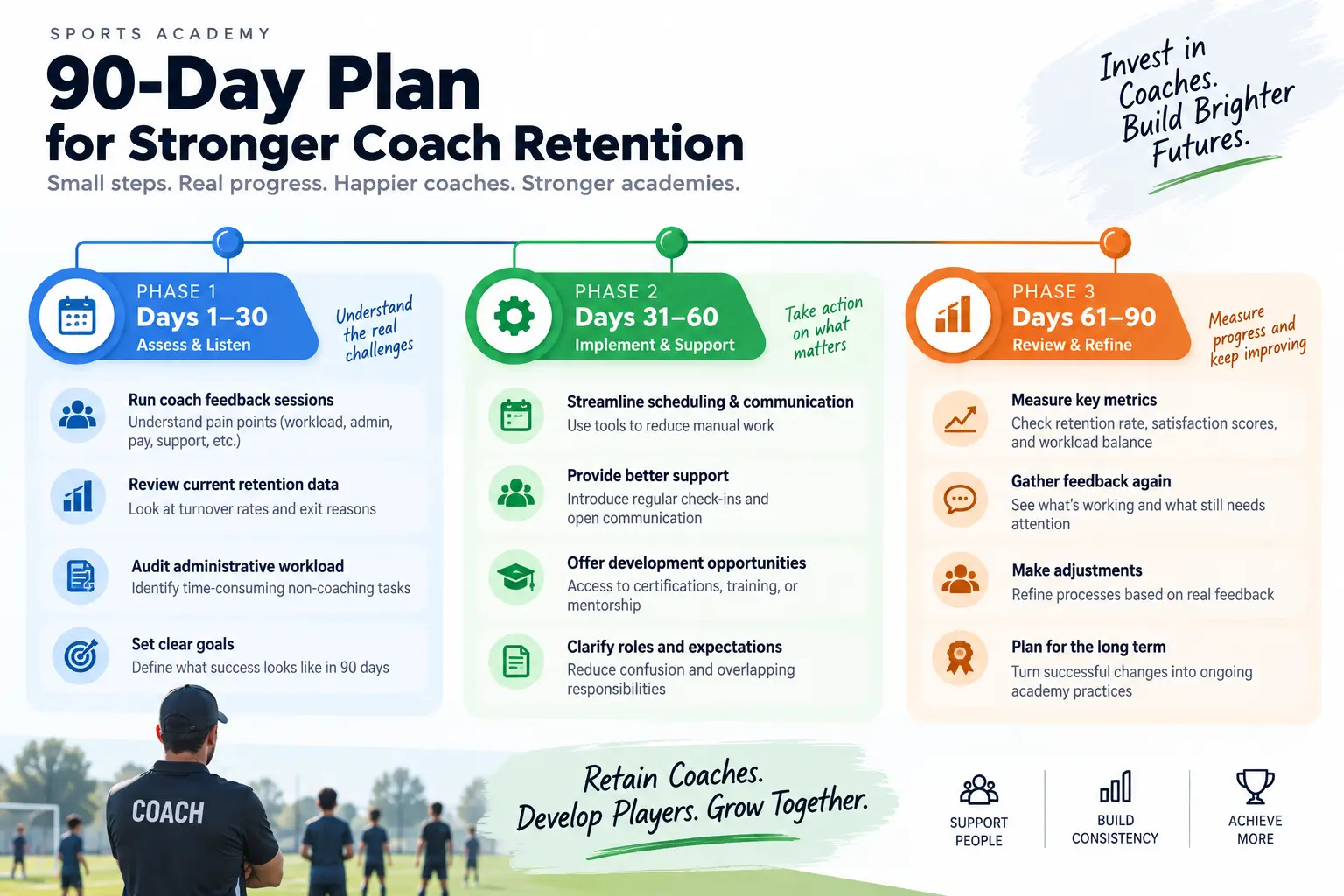
- Days 1–30: Audit Before You Act
Talk to current coaches about workload, not just performance. Look honestly at how much time goes into administrative tasks versus actual coaching. If coaches have left recently, try to understand why through informal exit discovery. - Days 31–60: Fix the Operational Friction
Address scheduling, communication, and administrative workflows directly. Redesign timetables around coach availability rather than building them in isolation. Move fee follow-ups and repetitive parent messages off coaches’ plates. - Days 61–90: Build the Structural Pieces
Formalize a career progression framework, put regular recognition practices in place, and begin tracking baseline retention metrics systematically.
How Everything Works Together
The real value comes from how these pieces talk to each other.
When a student hasn’t attended for three weeks, multiple people see the signal simultaneously. The coach gets a prompt that a regular student is missing. The admin sees the attendance pattern and notes that renewal is approaching. The system can automatically reach out to the parent: “We noticed [student] hasn’t been in since [date]. Everything okay? We’d love to see them back.”
When a parent asks about which batch to join, the system knows the student’s age, any previous experience in the academy, and fitness level from past assessments. It can recommend the right batch. Once admitted, the coach has context about where the student is starting from.
When a ground gets accidentally double-booked, a disconnected system might not catch it until both coaches show up. An integrated system flags the conflict when the second booking is made and suggests an alternative slot immediately.
Each of these features solves a different problem. When they work together, they make day-to-day academy management much easier to handle.
What an Ideal Sports Academy OS Should Consider
Current solutions have clear gaps.
Offline capability matters in outdoor sports. Coaches need to mark attendance and record notes without internet, syncing automatically when connectivity returns.
Sport-specific flexibility is important. A cricket academy needs different assessment fields and match statistics than a swimming academy, but both should use the same student record structure.
Safeguarding children’s information is non-negotiable. The system should enforce role-based access, manage consent for photos and videos, and maintain audit logs of who accessed sensitive information.
Frequently Asked Questions
What causes coach turnover in sports academies?
It’s rarely one factor. Compensation, unmanaged workload, administrative burden, limited career progression, weak management support, and parent or athlete-management pressure all appear repeatedly in coaching research as contributors, often layered on top of each other.
How can sports academies retain coaches?
By treating sports academy coach retention as an operational issue as much as an HR one fixing scheduling and workload, removing unnecessary administrative work, building visible career paths, and giving coaches real input into decisions that affect them.
How does burnout affect coach retention?
Research links burnout to a stronger intention to leave, rather than proving it directly causes every departure. Sustained burnout is still a reasonable early warning sign worth acting on before it turns into a resignation.
Can better scheduling improve coach retention?
The research doesn’t prove a direct causal link, but workload manageability and schedule control are both associated with better coach wellbeing a reasonable foundation for believing predictable, coach-informed scheduling helps.
What administrative tasks should coaches not handle?
Generally, anything that doesn’t require coaching judgment: fee chasing, repetitive scheduling messages, and manual attendance reconciliation are good candidates to move off a coach’s plate.
Can sports academy software reduce coach workload?
It can, when it genuinely removes repetitive manual work rather than just digitizing it. There isn’t independent evidence any specific platform reduces turnover directly, but reducing administrative friction is a reasonable, achievable goal.
How should an academy measure coach turnover?
Start with a basic retention rate and voluntary turnover rate, then layer in supporting metrics like six-month retention for new hires, median tenure, and documented exit reasons
Are bonuses enough to retain coaches?
Not necessarily on their own. Compensation matters, but the research points to career progression, workload, autonomy, and management support as equally important. A bonus rarely fixes frustration with an unmanageable schedule or a lack of any path forward.
Coach turnover isn’t solved by a single policy change or a single tool. It’s the product of dozens of smaller decisions how a schedule gets built, who chases an overdue fee, whether a coach’s input on team groupings actually gets heard.
Player development depends on continuity, and continuity depends on coaches who stick around long enough to know their athletes well. That, in turn, depends on manageable workload, management that communicates, a career path that goes somewhere, and administrative systems that don’t quietly eat into a coach’s evenings. Technology can help clear out repetitive work so coaches have more room for the job they signed up for. Academies that treat pay, workload, communication, and progression as parts of the same system end up with coaches who stay long enough to build lasting relationships with players, parents, and the organization.
Want to reduce the administrative workload on your coaching staff?
See how SportStr brings attendance, scheduling, and player evaluations together in one platform. .